Why household fans aren’t enough to dry out a flooded Jacksonville room
When your Jacksonville room floods grabbing every box fan from the garage feels like the right move. But here’s the hard truth: standard household fans cannot effectively dry out a flooded room in Northeast Florida’s climate. The science of water damage restoration requires industrial-grade equipment and specific techniques that go far beyond what you can buy at the hardware store. Florida Building Code Chapter 5.
Jacksonville’s average humidity sits above 70% year-round with summer months often hitting 90% or higher. This saturated air creates a perfect storm for trapped moisture allowing water to seep into walls under flooring and into structural components where it breeds mold within 24-48 hours. Standard fans simply move humid air around without removing the actual moisture content. Fast Flood Water Extraction for Jacksonville Beach Homeowners.
The physics of drying: why your box fan fails
Water damage restoration follows strict scientific principles outlined in the IICRC S500 Standard for Professional Water Damage Restoration. This standard establishes that effective drying requires three elements working together: air movement temperature control and dehumidification. Household fans provide only one of these three critical components. IICRC S500 Standard for Professional Water Damage Restoration.
Professional-grade air movers create high-velocity airflow that forces moisture to evaporate from surfaces. These machines move 3000+ cubic feet per minute (CFM) compared to a standard box fan’s 1000-1500 CFM. More importantly they’re strategically positioned to create a vortex effect that pulls moisture from deep within materials.

Jacksonville’s unique climate challenges
Jacksonville’s coastal location creates specific drying challenges that make DIY methods particularly ineffective. The St. Johns River’s influence keeps humidity levels consistently high while our frequent summer thunderstorms introduce additional moisture into the air. This combination means that even if you manage to evaporate surface water with fans the surrounding air immediately reabsorbs that moisture. Water Damage Restoration Neptune Beach.
Professional restoration companies use industrial dehumidifiers that remove 20-70 pints of water per day from the air. These machines work continuously to maintain specific humidity levels (typically 30-50%) that prevent reabsorption and promote rapid structural drying. A standard household dehumidifier removes only 30-50 pints per day and cannot keep up with the volume of moisture in a flooded room. Water Damage Restoration Green Cove Springs.
According to the Florida Building Code Chapter 5 moisture intrusion is one of the leading causes of structural damage in our region. The code specifically addresses the need for proper drying techniques in flood-prone areas like ZIP codes 32202 32204 and 32206 which sit near the St. Johns River and experience higher flood risks.. Read more about How Much Does Water Damage Restoration Actually Cost in Jacksonville?.
Diagnostic testing: what professionals look for
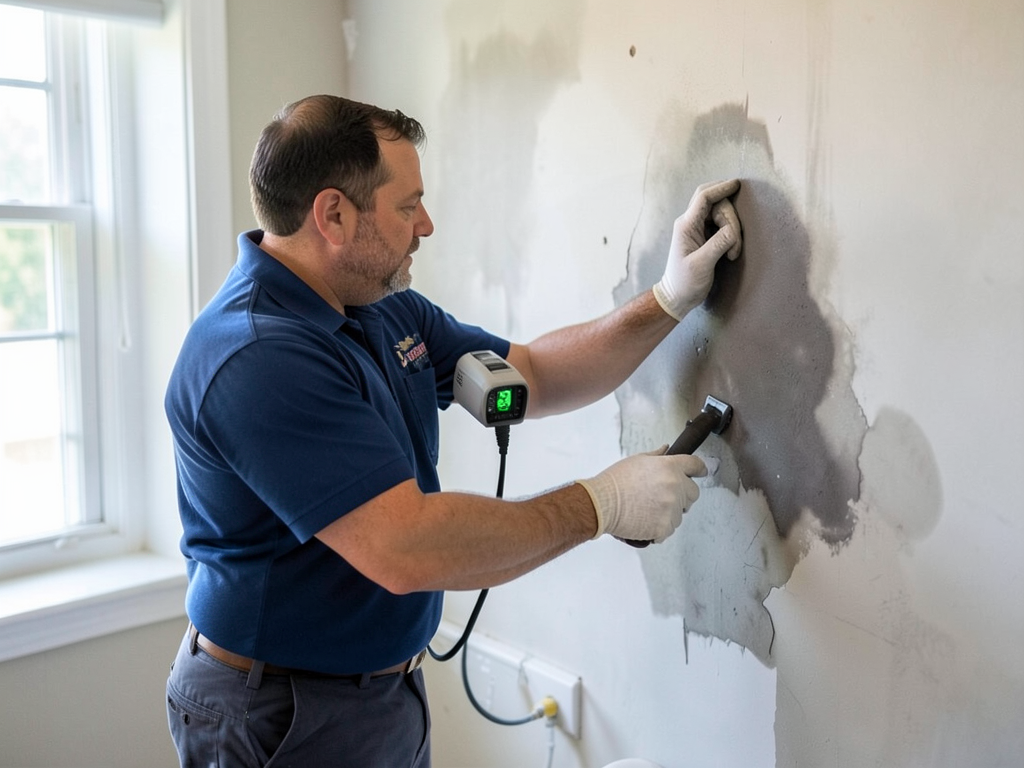
Professional water damage restoration technicians use specialized diagnostic tools that reveal what your eyes cannot see. A moisture meter reading of 15% or higher in drywall indicates water intrusion. Visual indicators include water stains bubbling paint and warping baseboards. These signs often appear in Jacksonville’s historic Riverside and San Marco neighborhoods where older construction methods leave buildings more vulnerable to water damage.. Read more about Is DIY water damage repair worth the risk for your Atlantic Beach home?.
Technicians also check for hidden moisture behind walls using infrared cameras. These cameras detect temperature differences that indicate water presence. In Jacksonville’s clay-heavy soil moisture can travel upward through foundations creating what professionals call “rising damp.” This phenomenon is particularly common in homes built before 1980 in areas like Springfield and Murray Hill. Removing Hidden Mold from Your Historic Riverside Home Safely.
Equipment comparison: household vs. professional
| Equipment Type | Household | Professional |
|---|---|---|
| Air Movement | 1000-1500 CFM | 3000+ CFM |
| Daily Water Removal | 30-50 pints | 20-70 pints |
| Temperature Control | None | Precision heating/cooling |
| Moisture Detection | Visual only | Infrared cameras moisture meters |
The science of evaporation and vapor pressure
Effective drying requires understanding vapor pressure differentials. Water moves from areas of high vapor pressure to low vapor pressure. Professional equipment creates these differentials by heating materials to 85-90°F while simultaneously removing moisture from the air. This process follows the psychrometric principles detailed in the IICRC S500 standard Section 4.2 which states that successful drying requires maintaining specific temperature and humidity conditions.
Jacksonville’s high ambient vapor pressure makes this process more challenging. Our coastal air already contains high moisture content. Professional restoration requires creating a controlled drying chamber where vapor pressure differentials can be maintained despite outdoor conditions. This is impossible with household fans which simply circulate the same humid air.. Read more about How long does it actually take to dry out a house in North Florida?.
Structural drying: beyond surface moisture
Water damage affects multiple building layers. Surface moisture evaporates quickly but water trapped in insulation drywall and structural framing requires aggressive drying techniques. Professional restoration uses injection drying systems that force dry air into wall cavities through small drilled holes. This technique can reduce drying time from weeks to days.
In Jacksonville’s older neighborhoods like Avondale and Ortega homes often contain plaster walls instead of drywall. Plaster requires different drying approaches because it retains moisture longer and can crack if dried too quickly. Professional technicians adjust their methods based on building materials following the IICRC S500 guidelines for different construction types.. Read more about Why newer homes in Oakleaf Plantation are still prone to hidden mold growth.
Time is critical: the 48-hour window
Mold begins growing within 24-48 hours of water exposure. In Jacksonville’s warm humid climate this timeline shortens significantly. Professional restoration companies work 24/7 to begin drying within the first 4-6 hours. This rapid response prevents secondary damage and reduces restoration costs.
Consider this scenario: A pipe bursts in your Mandarin home at 8 PM. By midnight surface water appears gone thanks to towels and box fans. However moisture remains trapped in walls and under flooring. Within 36 hours mold begins growing. By the time you notice the musty smell visible mold colonies have already formed. Professional intervention at this stage costs 3-5 times more than immediate response would have.
Insurance and documentation requirements
Insurance companies require specific documentation for water damage claims. Professional restoration companies provide moisture mapping before and after readings and detailed reports. These documents prove that proper drying techniques were used and help prevent claim denials.
The Florida Department of Financial Services mandates that licensed adjusters follow specific procedures for water damage claims. These procedures require proof of proper drying techniques which only professional equipment can provide. DIY attempts often result in denied claims leaving homeowners responsible for thousands in repair costs.
Why professional restoration costs more upfront but saves money long-term
Professional water damage restoration typically costs $3-5 per square foot for basic drying. This seems expensive compared to DIY methods. However consider the alternative: Mold remediation costs $15-30 per square foot. Structural repairs can cost $50-100 per square foot. The math becomes clear when you factor in the risk of incomplete drying.
Professional companies also work directly with insurance providers. They know exactly what documentation is needed and can often bill insurance directly. This service alone saves homeowners hours of paperwork and reduces stress during an already difficult situation.
Don’t let household fans turn a water problem into a mold disaster. Call (904) 839-6500 for professional water damage restoration in Jacksonville. Our team arrives within 60 minutes with industrial-grade equipment that follows IICRC S500 standards to protect your home and your health.
Common mistakes Jacksonville homeowners make
Many Jacksonville homeowners believe they can handle water damage themselves. This misconception leads to several common mistakes. First using household fans without dehumidification actually spreads moisture throughout the home. Second waiting 24-48 hours to call for help allows mold to establish itself. Third failing to document damage properly can complicate insurance claims.. Read more about The truth about using bleach to kill mold in a humid Jacksonville crawl space.
Professional restoration technicians know these pitfalls and avoid them. They understand Jacksonville’s specific challenges including our high humidity clay soil and frequent storms. This local knowledge combined with technical expertise ensures proper restoration the first time.
Preventive measures for Jacksonville homes
While professional restoration is essential after flooding some preventive measures can reduce your risk. First ensure proper grading around your home’s foundation. Water should flow away from not toward your home. Second install water sensors near appliances and in basements. These devices can alert you to leaks before they cause major damage.. Read more about Saltwater vs freshwater flooding and what it means for your Mayport property.
Third maintain your roof and gutters. Jacksonville’s frequent storms can overwhelm clogged gutters causing water to back up under shingles. Fourth consider installing a sump pump if your home sits in a low-lying area. ZIP codes 32204 and 32206 near the St. Johns River have higher water table levels making sump pumps particularly valuable.
Remember that even with these precautions flooding can still occur. When it does professional restoration following IICRC S500 standards is your best protection against long-term damage.
Water damage waits for no one. Call (904) 839-6500 now for 24/7 emergency water damage restoration in Jacksonville. Our industrial equipment and certified technicians will dry your home properly the first time preventing mold and protecting your investment.
You may also find this helpful. Five plumbing maintenance tasks to prevent flooding in your Deerwood estate.